US equities finished lower for the week as higher oil prices and weakness in semiconductors weighed on sentiment. The US Treasury announced this week that they would double their long-term bond buybacks. The improved liquidity and expectations triggered a substantial fall in long-term yields, an equity rally and a weaker dollar. However, yields have since begun to increase again as markets doubt the sustainability and impact of the policy.
China’s July retail sales only rose 0.6% year-on-year, below expectations, while industrial output slowed. The UK labour market cooled however UK inflation rose from 2.6% to 2.9% driven mainly by higher energy costs. Euro-area inflation was confirmed at 2.9% with core inflation at 2.5%.
Last week's highlights
 |
- Treasury Buybacks Announcement (19/08) - Treasury department will double buybacks of long-term government debt.
- S&P Global Flash PMI’s (21/08) - US business activity gained momentum in August with S&P Global’s composite PMI ticking up to 56 from 54.5 in July.
|
 |
- Euro-area final CPI (19/08) - Euro-area inflation was confirmed at 2.9% with core inflation at 2.5%.
- Euro-area Flash PMI’s (21/08) - S&P Global's Flash Eurozone Composite PMI reached its highest level since November, edging up to 52.1 from 52 in July.
|
 |
- UK Inflation Report (19/08) - UK inflation rose from 2.6% to 2.9% driven mainly by higher energy costs.
- UK Labour Market Report (18/08) - UK employers cut jobs in June and the number of vacancies declined. Unemployment rate came in at 4.9%.
|
 |
- China Retail Sales (17/08) – China retail sales growth slowed to 0.6% in July.
|
Looking ahead to this week, attention will turn to the Jackson Hole Economic Symposium, with investors watching closely for clues on the path of monetary policy. Markets are no longer expecting a Fed rate hike in September, following signs of easing inflation and a cooling labour market. Elsewhere, economic releases include German GDP data, the UK Nationwide House Price Index, Brazilian labour market figures and Tokyo Core CPI inflation.
What's on the radar
|
- Core PCE Price Index (26/08)
- Q2 GDP Preliminary Estimate (26/08)
- Jackson Hole Economic Policy Symposium (27/08 – 29/08)
|
|
|
|
- Nationwide House Price Index (28/08)
|
|
- Brazil Unemployment Rate – July (27/08)
- Tokyo Core CPI (28/08)
|
Chart of the moment - The Treasury Tab
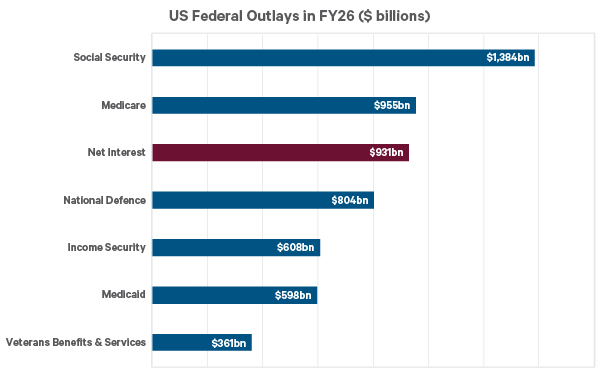
Source: US Department of the Treasury
Notes: The federal fiscal year begins on October 1 and ends on September 30. Medicare spending is net of offsetting receipts. Income Security includes military retirement, the Supplemental Nutrition Assistance Program, Supplemental Security Income, unemployment compensation, and housing assistance.
- Net interest costs have become one of the US federal government's largest expenses, reaching $931bn through July in FY26 and exceeding national defence spending.
- Interest payments are up around 11% year on year, driven by a combination of rising national debt and higher interest rates.
- Rising debt servicing costs are increasingly crowding out other spending priorities, with interest expected to be the fastest growing area of the federal budget over the next decade.